


Scrub Uniform Colors: What They Mean and Who Wears Them
Scrub uniform colors work as a visual job title. A hospital assigns a color to a role or a department, such as navy for nurses or green for the operating room, so patients and staff can tell who is who from across a hallway. There is no national color code, though. Each facility writes its own, and the color that marks a surgeon in one building can mark a technician in the next.
Some patterns hold nearly everywhere. Blue is the default for frontline nursing, green and teal belong to surgery, and white has faded because it stains and glares under bright lights. Pink, purple, and brown tend to appear where a softer tone helps patients relax.
This guide explains why the colors exist, how to find the one you are expected to wear, what each shade usually means, and which roles wear what. Blue Sky Scrubs has made scrubs and scrub caps for over 20 years, so we also cover how to buy in your assigned color without ending up with mismatched shades.
Why scrub uniform colors matter
Scrub colors matter because they solve three problems at once: they identify people quickly, they work under harsh lighting, and they put patients at ease. Each one shapes the way hospitals choose their colors.
They tell patients and staff who does what
Color coding lets anyone read a role in seconds. In an emergency, a nurse needs to find the respiratory therapist at once, and a worried family member needs to find someone who can answer questions. Some hospitals post a color chart in patient rooms for exactly that reason.

Many facilities also tie colors to restricted areas such as the OR, sterile processing, labor and delivery, and isolation units. A wrong color in the wrong place is easy to spot, which helps control who enters.
A scrub color is a job title that people can read from across the room.
They help under bright lights and ease nerves
Surgery adopted green and blue for practical reasons. Green sits opposite red on the color wheel, so it rests the eye against blood and tissue during long cases under bright lights. White did the opposite, glaring and showing every stain, and OR green has now been worn in operating rooms for over 50 years.
Color also shapes mood. Blue reads as calm and trustworthy, pink and prints soften pediatric visits, and earth tones feel less clinical in behavioral health. Treat these meanings as tendencies, not rules, because color affects emotion without guaranteeing any particular reaction.
How to find the scrub color you should wear
Ask your employer for the written dress code. Your facility's code, not a general chart, decides which of the scrub uniform colors is yours.
Start with the dress code
No law or professional body sets one national code, so the answer lives with your manager, your HR department, or your unit's dress code policy. Before you buy anything, get these five questions answered:
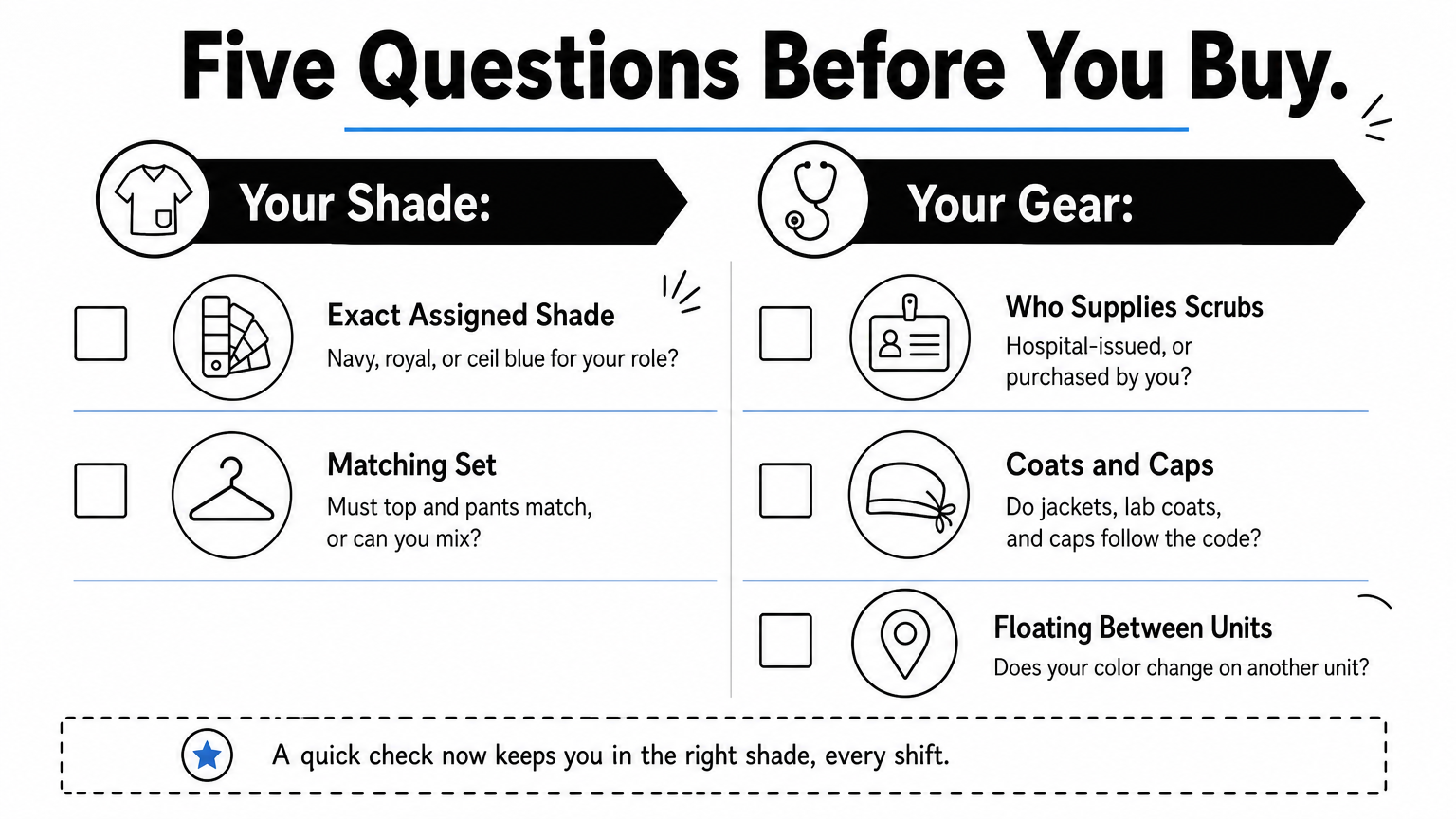
- Which exact shade is assigned to my role (navy, royal, or ceil blue)?
- Must my top and pants match, or can I mix colors?
- Are scrubs hospital-issued, or do I buy my own?
- Do the rules also cover jackets, lab coats, and scrub caps?
- Does my color change if I float to another unit?
Shade matters more than people expect. Navy and royal blue can mean different roles in the same building, so "blue" is not a good enough answer.
Check the dress code before you buy a single piece.
If you get to choose
Many clinics, dental offices, and private practices leave color up to you. Pick a color that no other role in your building wears, so patients do not mistake you for someone else. Then weigh upkeep: dark shades hide spills, and white shows everything.
Students often start with gray, light blue, or navy, though schools differ. If your color is fixed, personalization usually lives in the details, such as a patterned scrub cap or a different shade within the allowed family. Confirm that caps are not covered by the code before you buy.
What each scrub color means
Every color carries a typical meaning and a typical wearer, and the chart below pulls them together. Use it as a starting point and expect exceptions.
Scrub color chart
| Color | What it usually signals | Where you often see it |
|---|---|---|
| Navy and royal blue | Calm, trust, frontline care | Nurses, floor units, ICU, clinics, dental offices |
| Ceil and light blue | Approachable, clean | CNAs, support staff, pediatrics, some OR teams |
| Green, teal, OR green | Focus, healing | Surgeons, OR teams, PACU, endoscopy |
| Red, burgundy, wine | Urgency, energy | ED, trauma, phlebotomy, respiratory therapy |
| Purple | Compassion, wisdom | Oncology, women's health |
| Pink | Warmth, comfort | Pediatrics, women's health, child life |
| White | Cleanliness | Labs, pharmacy, diagnostics |
| Black | Polish, authority | Administration, security, some technicians |
| Gray, pewter | Neutral, modern | Support staff, technicians, students |
| Brown, tan, khaki | Grounded, relaxed | Behavioral health, therapy, patient companions |
| Yellow | Bright, energetic | Rare, mostly where staff choose freely |
Black, white, and wine: the confusing ones
Black raises the most questions. Hospitals use it for administrative staff, security, and some technicians, and a few systems assign it to pharmacy technicians or housekeeping. It looks sharp and hides stains, which is why private practices also like it.
White once belonged to nurses and physicians. Today it mostly marks labs, pharmacy, and diagnostics, because it stains easily and reflects glare. Wine and burgundy split by facility: some put them in the emergency department, others use them for administrative roles.
The same color can mean two different jobs in two different hospitals.
Scrub colors for nurses, doctors, and technicians
Nurses mostly wear shades of blue, surgeons wear green, and technicians wear whatever color separates them from both. Details change by facility, so use the patterns below as expectations.
Nurses
Navy and royal blue are the most common nurse colors, with ceil blue and wine also popular. White is traditional but less practical, so it survives mostly where a facility requires it. Women's scrub uniform colors follow the same palette, because the code assigns color to the role and not to gender. Only the cut differs.
Doctors and surgeons
Surgeons and OR teams wear green, teal, or OR green, along with anesthesiologists and PACU staff. Other physicians vary. Some hospitals give them their own color, often a medium or dark blue, while others allow any approved scrub color.

Technicians and support staff
CNAs and support staff typically wear a color that stands out from nursing, often light blue, gray, or another neutral. Contrast with the people above them is the point. The table below shows how colors for the same role differ across published dress codes.
| Role | Colors you may see |
|---|---|
| Respiratory therapist | Red or pewter |
| Pharmacy staff | White or black |
| Radiology | Royal blue |
| Patient transport | Red |
| Telemetry monitor technician | Maroon |
| Patient companion | Tan or khaki |
| Housekeeping | Black |
If you move between hospitals, expect your role to keep its title and change its color.
Buying scrubs and caps in your assigned color
Buy for the exact shade your code names, and buy the cap with the same care. A near match looks like a mistake next to a facility color.
Match the shade and the set
Dye shades vary between batches, so order tops and pants together when you can. Check whether the code names navy, royal, or ceil blue, since a store's plain "blue" may not be any of them. Wash dark colors cold and inside out to keep the shade even.
Don't forget the cap
Surgical caps usually follow the OR color. Blue Sky Scrubs makes solid-color caps in OR green, also called Surgical Green or Carnegie Green, plus Ceil Blue and Navy Blue. The OR Green Men's Scrub Cap is a 65% polyester, 35% cotton tie-back that you can machine wash cold. Solid caps are $24.99 each, so two for a rotation come to $49.98.
Wear the color your hospital assigns
Scrub uniform colors identify roles, ease patients, and help surgical teams see. No single code governs them, so your facility's dress code is the only chart that counts. Learn the exact shade first, then buy for it.
Once you know your color, the cap is the easiest piece to get right. Blue Sky Scrubs offers solid and printed styles, so you can browse women's scrub hats in your required color or in a pattern your dress code allows.


